Invention and Innovation
An enterprise real-time data platform at Synchrony Financial (2020–2026), and the research it produced.
The problem
Before 2020, frequently requested customer and account data was retrieved through external third-party calls. Each call carried a transaction cost and added latency across customer- and client-facing channels, at the scale of Synchrony's 70.7M active accounts[1] and 100M+ consumer credit accounts[2].
What I built
No equivalent capability existed in the organization. I conceived and led a new, reusable distributed caching and real-time data architecture, not a reimplementation of an existing system, and have owned its design and evolution since 2020. I lead the 50+ person global team that builds and operates it.
How the data path changed
Illustration only. Proportions are indicative, not live production data.
Architecture capabilities
- Distributed caching (GemFire) and event streaming (Kafka)
- Cache warming to pre-position frequently requested data
- Invalidation and consistency controls aligned to the source of record
- Cross-foundation replication for resilience and horizontal scale
- Configurable per consuming application or client, without redesign
- Hybrid deployment: on-premises, private cloud and public cloud
- Historical-statement extension: 100+ TB, 12–18 months of history, sub-100 ms response
Business impact
- 10B+ API data requests served per month at ~20 ms average
- $12–15 million annual cost avoidance from reduced external calls, changing how the business funds and operates its digital infrastructure
- Underpins web, mobile, customer-service and virtual-assistant experiences
- Powers analytics for customers, external clients and internal teams
- No re-platforming required across six years of growth (2020–2026)
Cost avoidance is my own figure from internal records; no public source exists.
Enterprise context
Also responsible for
Application architect for Synchrony's rewards platform, which supports the loyalty programs Synchrony funds for cardholders: points, cash back, statement credits and merchandise discounts across private label, Dual Card and co-branded cards. For a sense of scale, Synchrony's loyalty program costs grew by $343 million, or 52.9%, in 2021 alone[9]. That work informs the loyalty research below.
Research built on this work
Each paper formalizes a problem I first met in production. Newest first.
 Add photoimages/cais-2026.jpg
Session photo, presenter slide or certificateMulti-Agent Orchestration for Agentic Commerce: Coordinating Shopping, Payment, Rewards, and Fraud Agents in Real-Time Financial Transactions
How shopping, payment, rewards and fraud agents can coordinate within a single real-time transaction, built on the same kind of low-latency data infrastructure this platform provides.
ConferenceNeeded: paper link Add photoimages/ijca-paper.png
Journal logo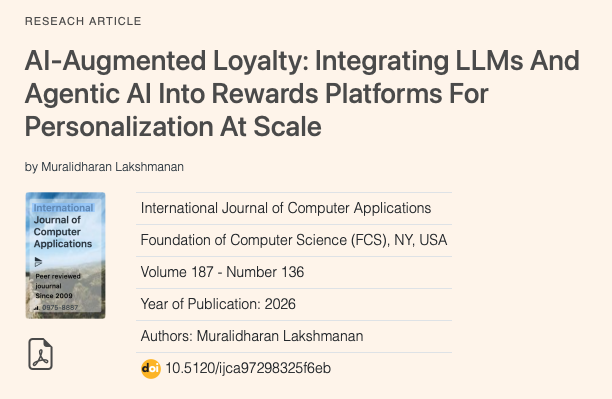 Add photoimages/ijca-article.png
Article page screenshotAI-Augmented Loyalty: Integrating LLMs and Agentic AI into Rewards Platforms for Personalization at Scale
Applying LLMs and agentic AI to personalization on rewards platforms, drawing on my work as architect of Synchrony's rewards platform.
 Add photoimages/ecpdc-2026.jpg
Title slide Add photoimages/ecpdc-2026-certificate.jpg
Presentation certificateA Self-Optimizing Multi-Agent AI Caching Architecture for High-Throughput Financial Systems
A self-optimizing, multi-agent caching architecture in which cooperating agents predict demand, prewarm keys and tune eviction, shaped directly by lessons from operating this platform.
Proprietary implementation details, internal identifiers and system topology are intentionally not published.
References
- Synchrony Financial — company information (70.7M active accounts, 31 Dec 2025)
https://investors.synchrony.com/company-information - Synchrony Financial — fact sheet (100M+ consumer credit accounts)
https://www.synchrony.com/s/fact-sheet.html - Synchrony newsroom — OnePay and Synchrony to launch new credit card (June 2025)
https://www.synchrony.com/contenthub/newsroom/onepay-and-synchrony-to-launch-new-industry-leading-credit-card.html - Synchrony Financial Form 10-K, 2018 — Amazon and PayPal named as partners
https://www.sec.gov/Archives/edgar/data/1601712/000160171219000053/synchrony1231201810k.htm - The Motley Fool — Synchrony Q2 2025 results, Amazon relationship renewed
https://www.fool.com/data-news/2025/07/24/synchrony-financial-q2-earnings-rise/ - ECPDC 2026 — 3rd International Conference on Edge Computing, Parallel and Distributed Computing
https://www.ic-ecpdc.org/ - Lakshmanan, M. AI-Augmented Loyalty. International Journal of Computer Applications 187(136), 16–21, Aug 2026. DOI 10.5120/ijca97298325f6eb
https://www.ijcaonline.org/archives/volume187/number136/ai-augmented-loyalty-integrating-llms-and-agentic-ai-into-rewards-platforms-for-personalization-at-scale/ - CAIS 2026 — International Conference on Artificial Intelligence and Simulation, Kuala Lumpur, 28–30 Sept 2026
https://www.ic-ais.net - Synchrony Financial Form 10-K, FY2021 — loyalty programs cost increased $343 million (52.9%)
https://www.sec.gov/Archives/edgar/data/1601712/000160171222000053/syf-20211231.htm
- Link needed: ECPDC 2026 paper DOI / ACM Digital Library link
- Link needed: CAIS 2026 paper or proceedings link